

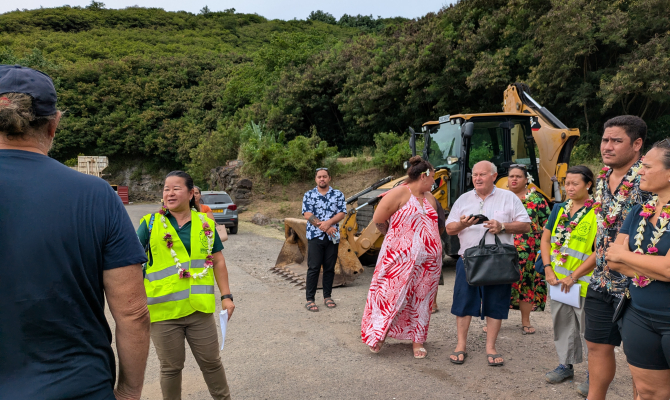
The Municipality of Moorea-Maiao has taken an important step forward in its transition towards more sustainable waste management with the official launch of its resource recovery project (“ressourcerie”). Dedicated to reuse, repair and the recovery of reusable items, this initiative represents a concrete step towards a more sustainable model better suited to the island context.
“A ressourcerie is not simply a place where objects are collected. It is a place where items are given a second life, where waste is reduced, and where social connections and economic activity are created,” said Mr Taivini Teai, Minister of Agriculture, Marine Resources, Environment, Food, Research and Animal Welfare of French Polynesia.
“The project led by Moorea-Maiao perfectly reflects the vision we aim to promote in French Polynesia: practical solutions designed locally and adapted to the realities of our islands.”

Implemented under the second phase of the ‘Sustainable Waste Actions in the Pacific’ (SWAP2) programme, funded by the Agence française de développement (AFD) with a total budget of EUR 4.3 million and implemented by the Secretariat of the Pacific Regional Environment Programme (SPREP), the resource recovery project is based on a close partnership between the Municipality of Moorea-Maiao and the Te Ui Rau association, which will play a central role in the operation and management of the facility.
The second phase of the SWAP project, launched in December 2024, enabled French Polynesia to join the programme after not participating in the first phase. This integration will allow the territory to further benefit from regional exchanges, sharing of best practices and capacity-building activities implemented across the Pacific. In this context, approximately EUR 310,000 has been allocated to activities in French Polynesia, including projects supporting the development of ressourceries across the territory, with the objective of establishing 20 ressourcerie by 2030.
“This ressourcerie is important for our municipality because it speaks not only about the environment, but also about solidarity and collective responsibility,” highlighted Mr Thierry Tapu, First Deputy Mayor of Moorea-Maiao.
“This ressourcerie should become a useful place for the community — a space for awareness raising, recovery and sharing, supporting a more circular and more local economy.”

This initiative is part of a broader waste prevention and reduction effort being carried out in French Polynesia under the SWAP2 programme.
A few days prior to the project launch, institutional stakeholders, associations and municipal representatives gathered in Tahiti for a training workshop on marine litter, organised in partnership with the French Polynesia Environment Directorate (DIREN), Fenua Environnement and Sustainable Coastlines. Audits conducted at Atimaono Beach in Papara and at the mouth of the Punaruu River in Punaauia highlighted the significant presence of diffuse litter, mainly plastics, within the coastal environment.
In a territory where waste management remains a major challenge, particularly due to geographical isolation and pressure on landfill sites, the ressourcerie offers a practical response. Based on circular economy principles, it will help intercept reusable items before disposal so they can be repaired, transformed or recirculated, thereby reducing the volume of waste sent to landfill.
“This project marks an important milestone for the Municipality of Moorea-Maiao and, more broadly, for French Polynesia. It reflects a concrete ambition: reducing waste, recovering resources and developing a circular economy adapted to island realities,” said Ms Marie Edan, Deputy Director for French Polynesia at the French Development Agency, during the launch ceremony.
Beyond its environmental benefits, the project also carries strong economic and social dimensions. The ressourcerie will contribute to the creation of local jobs, the development of repair and recovery skills, and the emergence of small-scale artisanal activities. It is also intended to serve as a place for awareness raising, encouraging residents to adopt more responsible consumption practices.

The results of the marine litter audits also highlighted the direct connection between land-based waste management and marine pollution. Despite the sometimes-clean appearance of the surveyed sites, teams identified significant quantities of plastic fragments, food packaging and small diffuse litter likely to rapidly reach the lagoon and the ocean. These findings reinforce the importance of strengthening prevention, reuse and waste reduction solutions at source, such as the future Moorea-Maiao ressourcerie.
At the heart of the initiative, the association Te Ui Rau will play a key role in the future operation of the facility. In addition to day-to-day management, the association will lead repair workshops and awareness activities, helping strengthen social cohesion and promote more responsible practices within the local community.
“Through this project, the objective is also to strengthen local capacities and provide practical solutions adapted to island realities. A ressourcerie is not just a place where objects are processed — it is a genuine space for awareness raising, learning and community engagement,” said Ms Julie Pillet, SWAP2 Project Manager at SPREP.
Participants in the workshop also stressed the importance of acting upstream to limit waste likely to reach coastlines and the ocean. “At first glance, the beach appeared clean. Yet after the collection exercise, we realised there was actually a large amount of waste to characterise. It shows that significant pollution can exist even when it is almost invisible. This is an important message to share: taking care of our Fenua,” explained Ms Marie-Louise Elian, Education and Awareness Officer for the association Oceania.
The project also highlights the importance of strong local partnerships. The close collaboration between the Municipality of Moorea-Maiao and the association Te Ui Rau represents a key factor in ensuring the long-term sustainability of the initiative. It helps anchor the ressourcerie within the local community and encourages ownership by residents.
The Minister also recalled that this initiative forms part of a broader ambition led by the Government of French Polynesia to progressively develop a network of ressourceries across the territory. “What we are launching today in Moorea-Maiao represents an important step towards structuring a genuine circular economy sector in French Polynesia,” he added.
“This project is not only about infrastructure. Above all, it relies on committed people,” Ms Edan reminded participants, emphasising the importance of local engagement to ensure the sustainability of the initiative.
Beyond Moorea-Maiao, this project forms part of a broader transformation of waste management in French Polynesia. Other complementary initiatives are already underway, including in Bora Bora, where a waste characterisation study will help better understand waste flows generated by tourism activities, and in Ua Pou, where a feasibility study will support the development of a ressourcerie project adapted to local constraints.

For the Secretariat of the Pacific Regional Environment Programme, which supports the implementation of the project, this initiative demonstrates the capacity of island territories to develop innovative solutions adapted to their own contexts. It also opens the way for possible replication in other municipalities and potentially in other Pacific Island countries.
With this launch, Moorea-Maiao is laying the foundations for a more sustainable model in which waste becomes a resource, and where the circular economy progressively becomes embedded in local practices and public policies across the territory.
ABOUT SWAP
SWAP2 contributes to the objectives of the Cleaner Pacific 2025 Strategy by improving waste management infrastructure, strengthening capacity and promoting regional collaboration. With total funding of EUR 4.3 million provided by the Agence française de développement (AFD), the programme supports nine Pacific Island countries and territories: Fiji, Solomon Islands, Kiribati, French Polynesia, Samoa, Tonga, Tuvalu, Vanuatu and Wallis and Futuna.
The Sustainable Waste Actions in the Pacific – Phase 2 (SWAP2) project is funded by the Agence française de développement (AFD) AFD and implemented by the Secretariat of the Pacific Regional Environment Programme (SPREP) SPREP. For more information, please visit SWAP Project Website or contact Ms Julie Pillet, SWAP Project Manager, at juliep@sprep.org.