


21 April 2026, Apia - The 2025–2026 La Niña event has ended. According to SPREP’s Pacific Islands Early Action Rainfall Watch (EAR Watch) for April 2026, sea surface temperatures in the central tropical Pacific have returned to El Niño-Southern Oscillation (ENSO) neutral range, and the atmospheric indicators are steadily settling toward neutral. The shift marks a significant transition point for Pacific Island communities, and the question of what comes next is now at the centre of attention for National Meteorological and Hydrological Services (NMHSs) across the region.
El Niño-Southern Oscillation (ENSO), is a major driver of year-to-year variability in the region, cycling between two extreme phases. During La Niña, cooler-than-average sea surface temperatures in the central and eastern tropical Pacific bring wetter conditions to many western Pacific islands. During El Niño, those waters warm and the pattern often reverses, bringing drier conditions to the same communities.
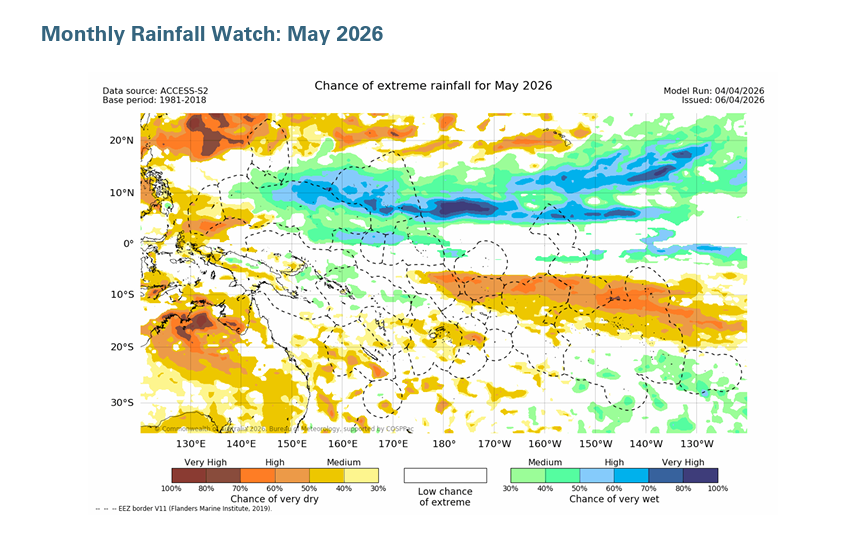
The EAR Watch Bulletin which is produced for Pacific disaster managers highlights the contrasting conditions that shaped the Pacific over the past three months. Across the northern Pacific, CNMI, Guam, northern Palau, northern FSM, and the northern and central Marshall Islands recorded very wet to seriously wet conditions from January to March 2026. In the south Pacific, southeastern PNG, the Solomon Islands, central and southern Vanuatu, New Caledonia, southern Fiji, Niue, and the southeastern Cook Islands all received rainfall well above historical norms.
The dry side of that picture was equally pronounced. Eastern and southern FSM, PNG’s mainland and northern islands, northern Solomon Islands, Kiribati’s Phoenix and Line Islands, southern Tuvalu, Wallis and Futuna, Samoa, most of the Cook Islands, and central and northern French Polynesia all came in at the dry end of the historical record, straining water supplies, affecting crops, and compounding pressures on communities that were already managing difficult conditions.
This season also brought reminders that Pacific hazards rarely arrive in isolation. The formation of twin tropical cyclones on either side of the equator within the same period illustrates how circulation patterns can simultaneously compound dry conditions in one location and flooding in another. It is precisely this complexity that makes platforms such as the Pacific Regional Climate Centre (RCC) Network Pacific Islands Climate Outlook Forum (PICOF) so important for regional climate coordination.
It is within this context that climate scientists from Pacific NMHSs will convene at PICOF-18 later this month. PICOF brings together NMHS representatives from across 15 Pacific Island countries to review the climate over November 2024 to April 2025 and outlooks for May to July and August to October 2026 that national teams carry home to guide planning and decision-making. In addition, NMHS representatives will review the 2025/26 tropical cyclone season, discuss the likelihood of El Niño developing later in 2026, and work through the implications for communities whose livelihoods depend on reliable, locally relevant climate information.
For farmers, fishers, water managers, and disaster risk officers, the consensus outlook produced at PICOF is among the most practically grounded climate products available at regional scale. Climatologists do not simply relay global model outputs, but they interrogate them, reconcile differences and produce guidance that is nationally relevant and locally useful. That is the value the forum has delivered for nearly two decades, and what it will seek to deliver again when it convenes in Nadi, Fiji.
Community members are also encouraged to observe traditional and local knowledge indicators, such as the behaviour of birds, fish, plants and winds, which Pacific peoples have long used to read seasonal change and which remain a valuable complement to scientific forecasting.
PICOF-18 will be held from 23 to 24 April 2026, in Nadi, Fiji, and will be attended by more than 35 professionals from 15 NMHSs across the Pacific. Technical support will be provided by the Bureau of Meteorology Australia (BoM), Earth Sciences New Zealand (ESNZ), the Commonwealth Scientific and Industrial Research Organisation (CSIRO), the University of Hawaiʻi (UoH), Météo France, the National Oceanic and Atmospheric Administration (NOAA), the APEC Climate Centre, the Pacific Community (SPC), and the Secretariat of the Pacific Regional Environment Programme (SPREP).
PICOF-18 is made possible through joint funding from the European Union-funded Climate Services and Related Applications programme (ClimSA), the Climate and Oceans Support Programme in the Pacific (COSPPac), the Republic of Korea-Pacific Islands Climate Prediction Services Project (ROK-PI CLIPS), and the UN Environment Programme Enhancing Climate Information and Knowledge Services for Resilience in 5 Island Countries of the Pacific Ocean (CIS-PAC5).
The Pacific Islands Early Action Rainfall Watch for April 2026 is available from the SPREP website. Local meteorological services should be contacted for detailed national outlooks.