


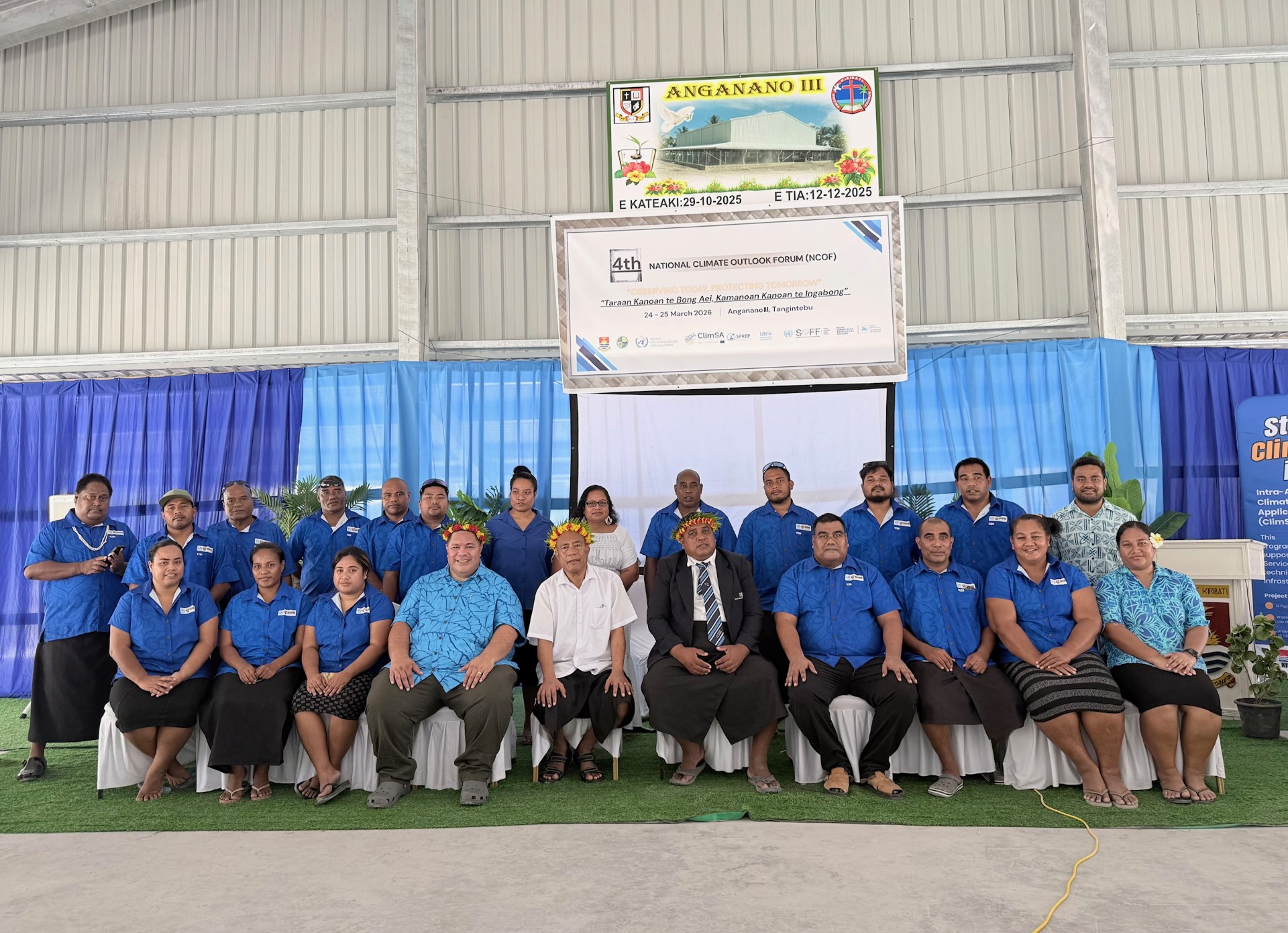
The Kiribati Meteorological Service (KMS) convened the fourth National Climate Outlook Forum (NCOF) in Tarawa in March this year, bringing together Mayors and Clerks from across Kiribati’s 33 islands, alongside national ministries, disaster risk reduction agencies, development partners and members of the diplomatic corps, for substantive dialogue on the latest climate and ocean outlook for the coming season.
The Forum carries particular significance this year. In June 2023, after an eight-year lapse, the Kiribati Meteorological Service reconvened the National Climate Outlook Forum in Tarawa, which brought together more than 25 participants for two days of in-depth discussion. That reconvening marked both a renewed national commitment to climate services and the beginning of a formative partnership with the Secretariat of the Pacific Regional Environment Programme (SPREP), through the European Union’s Intra-ACP Climate Services and Related Applications (ClimSA) Programme. Now in its fourth year of implementation, ClimSA has supported every edition of the Forum since its restoration. The fourth NCOF is a direct reflection of that continuity.
“While disseminating weather and climate information through various channels is important, direct engagement with community leaders is indispensable. The National Climate Outlook Forum serves as a vital platform for sharing this information with island leaders,” said His Excellency Taneti Mamau, President of the Republic of Kiribati.
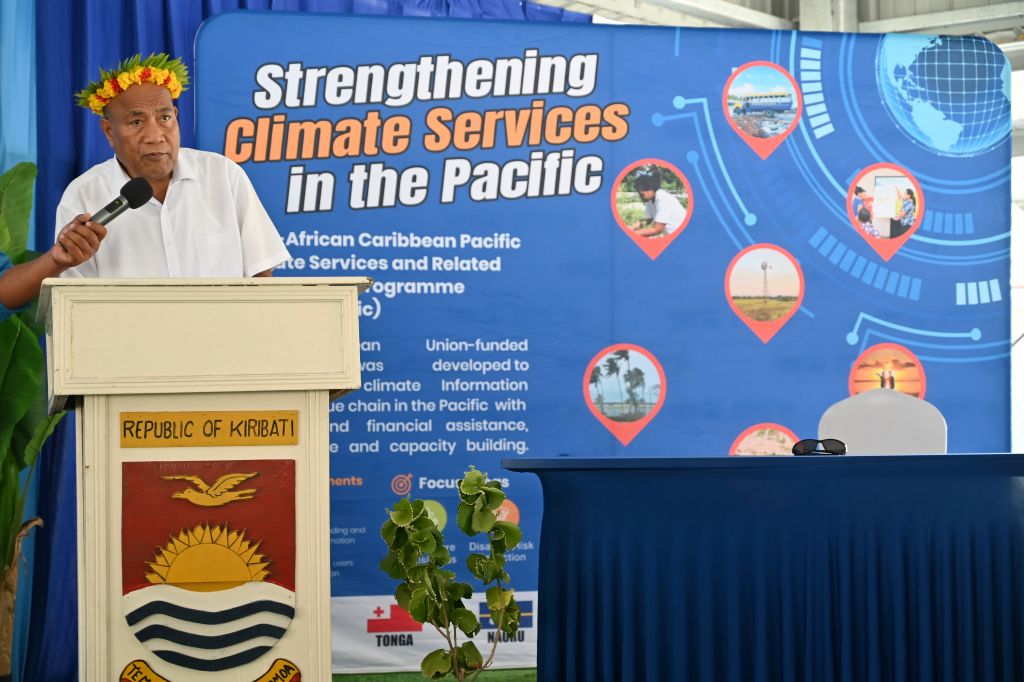
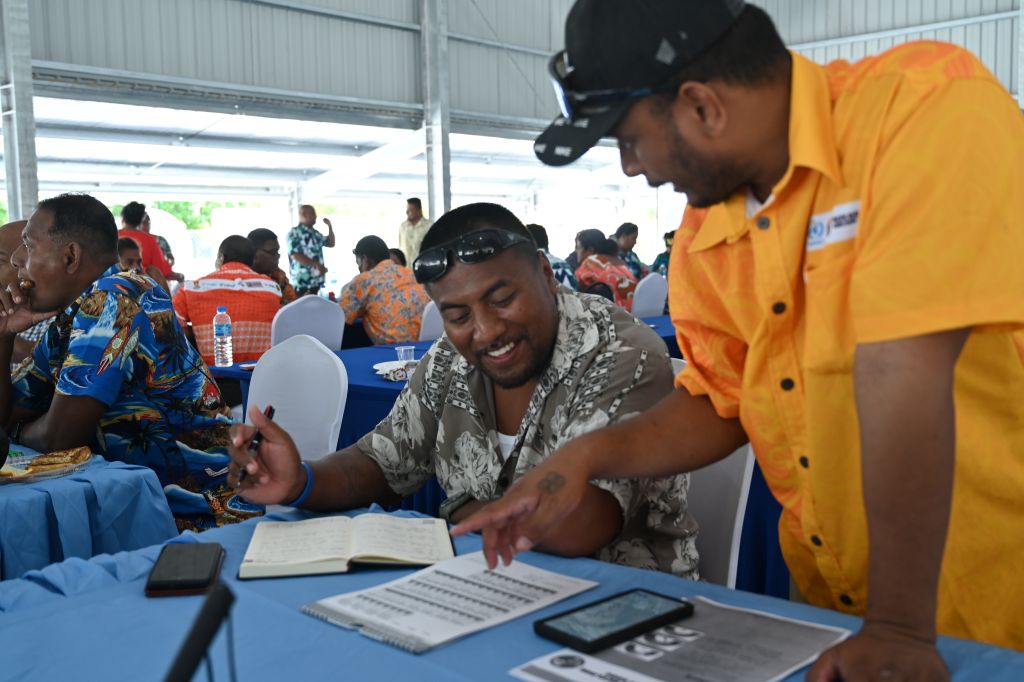
The NCOF is the primary national platform for promoting understanding of meteorological events and facilitating the exchange of climate information between the Kiribati Meteorological Service and the range of sectors that depend on it. Given Kiribati’s geography, comprised of 33 islands dispersed across 3.5 million square kilometres of ocean, the Forum is hosted in two locations: Tarawa for the Gilbert Islands group, and Kiritimati for the Line and Phoenix Island groups.
"Four years ago, this Forum did not exist. Today, it is the thread connecting a climate forecast in Tarawa to a decision on an outer island. That thread must not break. Every year that we gather, every Mayor who returns to their island with a forecast in hand, is proof that sustained investment in climate services saves lives,” reaffirmed Mr. Salesa Nihmei, Director of SPREP’s Climate Science and Information Programme.
“The European Union's investment through ClimSA has made this continuity possible but continuity is exactly what’s needed. Climate services only work when communities can rely on them year after year. One forum is a start, four forums, without interruption, is a system. That is what we are building with the Kiribati Meteorological Services,” added Mr. Nihmei.
This year’s Forum takes place against the backdrop of a deepening institutional partnership between SPREP and KMS. A Letter of Agreement under the ClimSA Project, valued at AUD 405,153.53 and extending through November 2027, underpins a programme of concrete investment in Kiribati’s meteorological infrastructure. This includes the installation of three new Automatic Weather Stations on Nikunau, Kuria, and Abaiang; the deployment of five wave buoys at pilot sites around Butaritari, Maiana, Beru, Arorae, and Kiritimati; IT infrastructure expansion and archive modernisation at KMS; a data rescue and digitisation initiative, including employing a dedicated Data Rescue and Digitisation Officer, to safeguard historical climate records; and the installation of ENSO signboards in Buota, Butaritari, Kiritimati, and Beru to extend the reach of climate information to outer island communities.
Beyond ClimSA, KMS continues to benefit from complementary support through SPREP’s Weather Ready Pacific programme and the DFAT-funded COSPPac project, which strengthens sub-seasonal and seasonal prediction capability through data archival into the CliDE database and integration into the Ocean and Climate Outlook Forum. The Republic of Korea–Pacific Island Climate Prediction Services Project Phase 3 further supplements KMS capacity through advanced climate modelling tools and targeted training for staff.
Looking ahead, SPREP is supporting the finalisation of the Kiribati Meteorological Strategic Plan 2026 – 2036, a ten-year institutional roadmap aligned with the Kiribati 20-Year Vision (KV20). The Plan prioritises sustainable financing to reduce donor dependency and builds in-house capacity for aviation and marine forecasting. A Validation Workshop is scheduled for June, with an official launch planned for Kiritimati in October.
“The ClimSA programme is committed to supporting the Kiribati National Climate Outlook Forum and aims to ensure that all stakeholders have improved understanding of weather, climate and ocean products and services, whilst supporting the Kiribati Meteorological Services in meeting their information needs,” reaffirmed Mr. Nihmei.
While these investments represent meaningful progress, SPREP has been transparent about the broader resourcing landscape. The Weather Ready Pacific programme, the regional blueprint for protecting Pacific lives from weather and climate hazards, still requires USD 160 million to implement unfunded activities across member countries. Closing this gap remains a shared regional priority.
The NCOF is the primary national platform for exchanging climate and ocean information between KMS and key sectors including fisheries, disaster risk reduction, health, education, transport, and island governance. After an eight-year lapse, the Forum was reconvened in June 2023 with ClimSA support. The fourth NCOF, held on 24 - 25 March 2026 in Tarawa, is the latest.
The Intra-ACP Climate Services and Related Applications (ClimSA) Programme is a EUR 9 million initiative funded by the European Union and implemented by SPREP. It is dedicated to enhancing the production, accessibility, and application of science-based climate information to empower decision-makers across the Pacific.